


2.3.3 Sustainable food choices on campus
SUSTAINABLE FOOD OPTIONS ON CAMPUS
Introduction and Objectives
Boğaziçi University is committed to providing sustainable food options. Our university has adopted the principle of providing the best quality and satisfaction to our students, academic and administrative staff. With our trained and experienced production staff and other personnel, we aim to ensure food safety in healthy and hygienic environments in accordance with the standards, paying utmost attention to nutritional rules. We have adopted "Total Quality" as a business principle and philosophy of life by guiding all our employees with team spirit, meeting the needs and demands in the best way, adopting social responsibility standards and achieving "Total Quality" in line with the understanding of continuous improvement.
Sustainable Food Options and Services
Vegetarian and Vegan Food Options: Our campuses offer sustainable food options for everyone, including vegetarian and vegan dining options. These options support healthy and environmentally friendly eating habits.
Canteen and Cafeteria Inspections: Our university contributes to healthy, balanced and affordable nutrition by inspecting canteens and cafeterias. These inspections ensure that hygiene and quality standards are maintained.
Catering Services: Boğaziçi University cafeterias serve food to students 7 days a week and to our staff 5 days a week. Breakfast, lunch and dinner are served on weekdays and weekends within the dates specified in the academic calendar.
The meal service hours are as follows according to the campuses:
- Weekday Service Hours:
|
Campus |
Breakfast |
Lunch |
Dinner |
|
North |
07:30 - 09:30 |
11:30 - 14:30 |
17:00 - 19:15 |
|
South |
07:30 - 09:30 |
12:15 - 14:30 |
17:00 - 19:15 |
|
Kilyos |
07:30 - 10:00 |
12:00 - 15:00 |
17:00 - 19:15 |
|
Kandilli |
07:30 - 09:30 |
11:30 - 14:30 |
17:00 - 19:15 |
|
Hisar |
Not Available |
11:30 - 14:30 |
Not Available |
|
Anadolu Hisarı |
07:30 - 09:30 |
11:30 - 14:30 |
17:00 - 19:15 |
- Weekend Service Hours:
|
Campus |
Breakfast |
Lunch |
Dinner |
|
North |
08:30 - 10:00 |
12:00 - 13:45 |
17:30 - 19:30 |
|
South |
08:30 - 10:00 |
12:00 - 13:45 |
17:30 - 19:30 |
|
Kilyos |
08:30 - 10:00 |
12:00 - 13:45 |
17:30 - 19:30 |
|
Kandilli |
08:30 - 10:00 |
12:00 - 13:45 |
17:30 - 19:30 |
|
Anadolu Hisarı |
08:30 - 10:00 |
12:00 - 13:45 |
17:30 - 19:30 |
Employees
- Hakan DENİZ
- Office Personnel
- Food Services Branch Directorate
- hakan.deniz@bogazici.edu.tr
- 0(212) 359 4460
- Barış PANCAR
- Food Engineer
- Food Services Branch Directorate
- baris.pancar@bogazici.edu.tr
- 0(212) 359 6730
- Aygül DEMİR YOLASIĞMAZOĞLU
- Branch Manager
- Food Services Branch Directorate
- aygul.demir@bogazici.edu.tr
- 0(212) 359 7110
- İsmet GÜNDOĞAN
- Office Personnel
- Food Services Branch Directorate
- ismet.gundogan@bogazici.edu.tr
- 0(212) 359 4460
- Gül GÜLER
- Food Engineer
- Food Services Branch Directorate
- gul.guler@bogazici.edu.tr
- 0(212) 359 6729
Conclusion and Expected Effects
Boğaziçi University aims to increase the availability of healthy and nutritious food on campus, fulfilling its commitment to providing sustainable food options. Through the inclusion of vegetarian and vegan options, canteen and cafeteria audits, catering services and staff contributions, the nutritional needs of the university community are best met.
These efforts will have a positive impact on the academic and professional success of students and staff and contribute to the fulfilment of Boğaziçi University's social responsibilities.
Boğaziçi University Canteen and Cafeteria Inspection Commission Working Directive
Boğaziçi University Receives Full Marks for Sustainable Food Choices on Campus!
Boğaziçi University considers providing sustainable and inclusive food choices on campus as an integral part of its healthy living policies. This institutional approach has been recognised through the “Nutrition-Friendly and Physical Activity-Supporting Workplace” certificate awarded under the programme implemented by the Ministry of Health of the Republic of Türkiye.
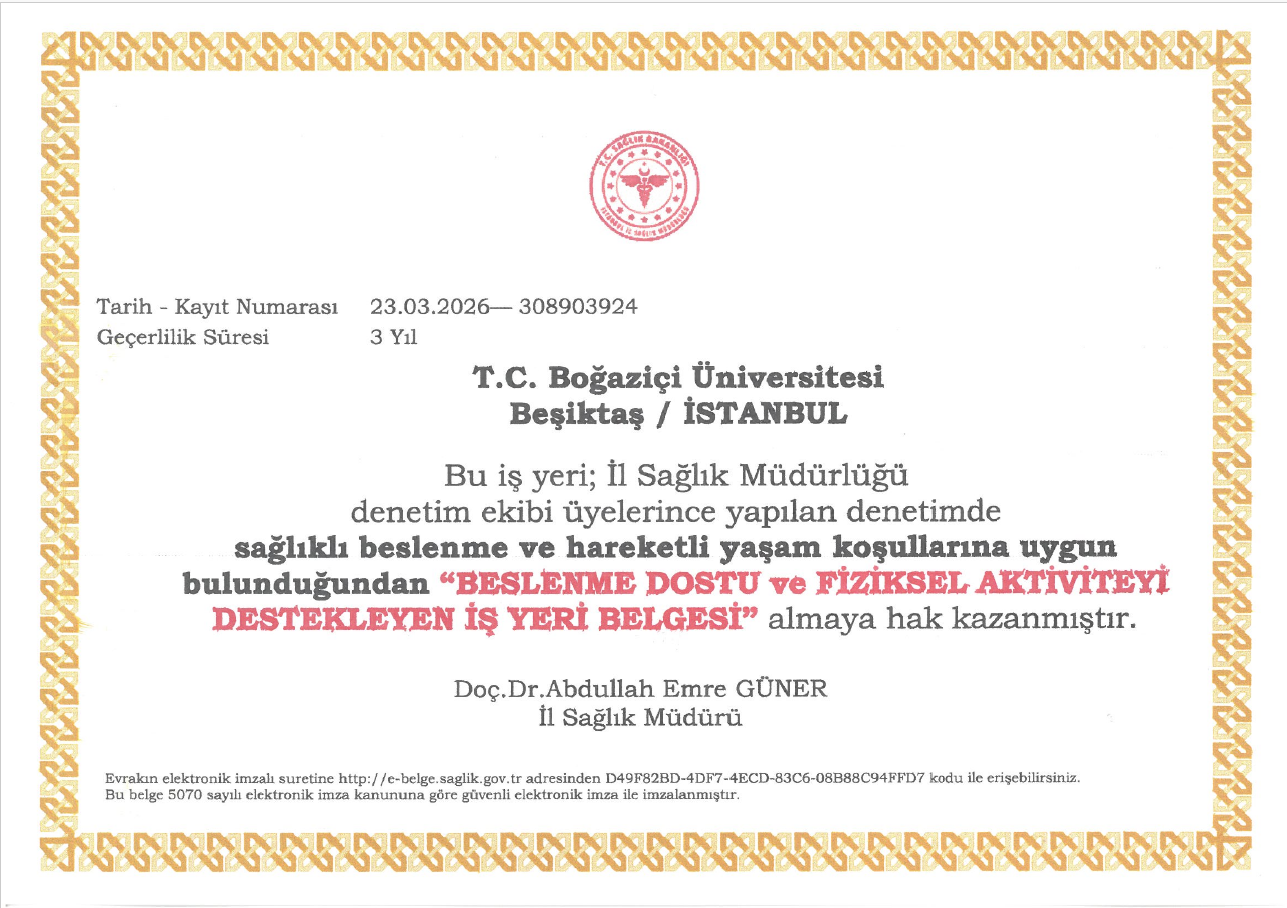
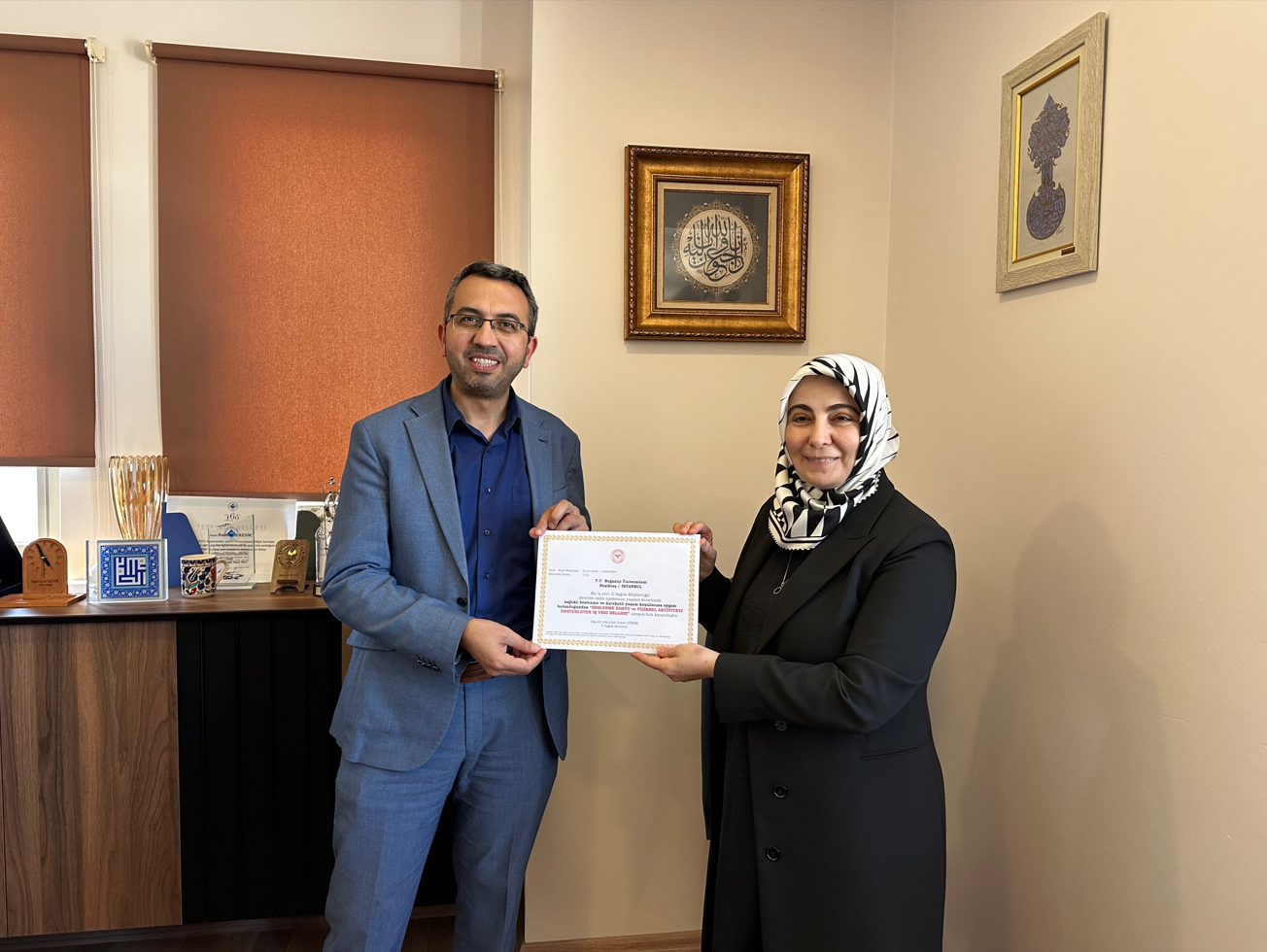
As a result of its systematic quality-assurance processes and practices supporting healthy nutrition, Boğaziçi University received the certificate with a full score of 100 out of 100. The certificate, awarded in 2026 and valid for three years, was presented by Dr Fatma Zehra Güneşer, Beşiktaş District Health Director, to Ramazan Kesik, Head of the Department of Health, Culture and Sports.
Within the scope of the certification assessment, campus food services were evaluated against criteria such as preparing menus that meet users’ needs, taking special dietary requirements into account, making healthy options visible and accessible, and avoiding the promotion of foods high in saturated fat, sugar, salt, and energy. This process strengthens the University’s institutional commitment to supporting healthier, more accessible, and more sustainable food choices across campus.
The Nutrition-Friendly and Physical Activity-Supporting Workplace Programme Implementation Guide and assessment criteria are available here.
2024 Sustainability Report SDG-2 (Related Section)
Sustainable Food Options on Campus
Boğaziçi University attaches great importance to the principles of sustainability in the catering services provided on campus and aims to ensure that students and staff have access to healthy, balanced and environmentally friendly food. The university's catering services are supported by various practices that aim to minimise environmental impacts while promoting healthy eating.
Procurement from Reliable Sources: All foodstuffs used in Boğaziçi University catering services are procured in accordance with the Foodstuffs Regulation (GMT) and Turkish Standards Institute (TSE) standards. Vegetables and fruits with parasites, chemical fertilisers, visible pesticide residues, insect residues, and meat containing toxins, hormones, drugs and disinfectants are not accepted. This rigorous procurement process supports sustainability and reliable sourcing.
Sustainable Food Choices and Menus: Offering vegan/vegetarian options at every meal in Boğaziçi University cafeterias is an important part of the sustainable food policy. Since more resources are consumed during the production of animal products, plant-based options contribute to reducing the carbon footprint. With at least one vegan or vegetarian main course alternative at every meal, the consumption of environmentally friendly foods is encouraged and diversity is provided for students and staff with different dietary preferences.

Resource Efficiency and Prevention of Food Waste: Prevention of food waste and efficient use of resources are key elements of sustainable catering services. At Boğaziçi University, excessive consumption is prevented through portion control, and students and staff are served meals in appropriate quantities. At the same time, projects that reduce the amount of waste and contribute to environmental sustainability, such as composting to utilise leftovers, are also implemented. Integrated solutions are also produced through social responsibility projects such as the delivery of leftover meals to those in need.
Sustainable Nutrition with Local and Seasonal Food: In Boğaziçi University catering services, all vegetables and fruits are locally produced and used in season. All meat used is local animal meat. The preference for seasonal and local products contributes to the local economy, reduces carbon emissions from transport and contributes to a smaller carbon footprint of food. Thus, the meals served on campus are prepared with the awareness of environmental protection and contribute to the adoption of sustainable eating habits.
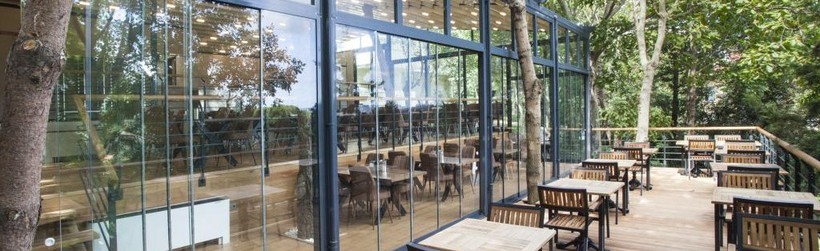
Transparent and Reliable Trade Partnership: Boğaziçi University adopts a co- operation model that covers all procurement, preparation and service processes for breakfast and catering services offered in campus dining halls. The meals are prepared in the kitchen of the North Campus cafeteria, and all stages from procurement of food ingredients to service are carried out by the contractor company in accordance with a comprehensive technical specification prepared by the Department of Health, Culture and Sports. The contract signed between the university and the contractor company aims to secure a business partnership based on open communication, transparent processes and mutual respect in accordance with the principle of sustainability.
