


17.4.2 Education for SDGs: specific courses on sustainability
Special Courses on Sustainability and Sustainable Development at Boğaziçi University
Boğaziçi University offers a variety of undergraduate and graduate programmes that address sustainability and the Sustainable Development Goals (SDGs). These programmes include courses and degrees that aim to specialise in environmental, social and economic sustainability. Here are some of the programmes and courses offered at the university in line with these goals:
1. Master's Programme in Sustainable Tourism Management
This programme is a graduate programme that aims to address tourism activities in Turkey from a sustainability perspective and to minimise the environmental impacts of tourism. The programme is the first and only programme in Turkey to provide education in the field of sustainable tourism. It also aims to contribute to the human resources required in this field by examining global sustainable tourism practices.
2. Institute of Environmental Sciences
Boğaziçi University Institute of Environmental Sciences offers master's and doctoral degrees in environmental sciences and environmental technology. Students can specialise in areas such as socio-ecological sustainability, urban waste management, renewable energy by taking courses such as sustainable development, global climate change, social ecology.
3. Fuel and Energy Technologies Non-Thesis Master Programme
This is a master's programme that teaches sustainable energy technologies to engineers who aim to play a leading role in the fuel and energy sector. The programme includes courses covering the conversion of renewable energy sources, energy-environment relationship and sustainability.
4. Executive MBA and MBA Programmes
The Executive MBA programme covers sustainability topics such as renewable energy, carbon finance, corporate social responsibility, green marketing and environmental law. The MBA programme offers courses on ethical issues management, environmental ethics and sustainable business ethics.
5. Social Policy Master Programme
This programme includes courses that address the root causes of social problems such as poverty, social exclusion and inequality and offer solutions towards sustainable development goals. The programme aims to provide in-depth analyses in areas such as social policies, health, education, employment and gender.
6. Peace and Conflict Lectures
Peace education courses offered by the Department of Political Science and International Relations and the Department of Educational Sciences address issues such as human rights, social justice, disarmament and intercultural solidarity. These courses focus on peacebuilding, reconciliation and conflict resolution.
Boğaziçi University offers a variety of undergraduate and graduate programmes to support sustainable development goals and to equip students with the necessary skills. These programmes include a wide range of elective and compulsory courses that promote environmental, social and economic sustainability.
2024 Sustainability Report SDG-17 (Related Section)
Training for the SDGs: Specialised Courses on Sustainability
Boğaziçi University offers a variety of undergraduate courses and graduate programmes that address sustainability and the Sustainable Development Goals (SDGs). These programmes include courses and degrees that aim to specialise in environmental, social and economic sustainability. Some of the programmes and courses offered at the university in line with these objectives are as follows:
1. Institute of Environmental Sciences Programmes
Boğaziçi University Institute of Environmental Sciences offers master's and doctoral degrees in the fields of ‘Environmental Sciences’ and ‘Environmental Technology’. Students can specialise in Urban Waste Management and Renewable Energy (W2E), Pollution Control and Modelling (PCM), Molecular Ecology and Microbial Biotechnology (MNM), Socio-Ecological Sustainability (SES) according to their courses and thesis studies. In addition, the Institute of Environmental Sciences offers undergraduate courses on sustainability such as ‘Sustainable Development’, ‘Global Climate Change’,‘Social Ecology’.
Click here for information about the programmes:
https://bogazici.edu.tr/tr_TR/Content/Akademik/Lisansustu_Katalogu/Cevre_BilimleriEnstitusu
Click here to see the graduate course contents:
https://iesc.bogazici.edu.tr/tr/graduate-courses
Click here to see the undergraduate course contents:
https://iesc.bogazici.edu.tr/tr/courses
2. Chemical Engineering Programmes
Chemical Engineering undergraduate and graduate programmes offer a remarkable diversity of sustainability-oriented educational content. At the undergraduate level, there are courses such as ‘Renewable Energy Technologies,’ ‘Operation and Environmental Safety in Chemical Plants,’ and‘Hydrogen Technologies,’ while the master's and doctoral programmes include‘Analysis of Sustainable Technologies’ and‘Catalysis for Green Technologies’ courses. These courses aim to equip future engineers with both theoretical knowledge and practical approaches by addressing the concept of sustainability in the context of energy, environment and technology.
Click here for information about the undergraduate programme:
https://bogazici.edu.tr/tr/pages/lisans-programlari/58
Click here to get information about the graduate programme:
https://bogazici.edu.tr/tr/pages/lisans-programlari/58
3. Civil Engineering Programmes
Civil Engineering undergraduate and graduate programmes offer a variety of sustainability-related course content. At the undergraduate level, courses such as ‘Environmental Engineering Design,’ ‘Hydraulic Engineering,’ ‘Transportation Systems Engineering,’ ‘Foundation Engineering,’ and ‘Environmental Engineering’ provide students with basic knowledge on sustainable infrastructure, resource management, and mitigation of environmental impacts. At the graduate level, advanced courses such as ‘Environmental Geotechnology’ and ‘Soil Behaviour’ focus on the study of soil and environmental relations within the framework of sustainability. These programmes aim to provide the necessary knowledge and skills to develop sustainable engineering solutions.
Click here for information about the undergraduate programme:
https://bogazici.edu.tr/tr/pages/lisans-programlari/60
Click here to get information about the graduate programme:
https://bogazici.edu.tr/tr/pages/lisans-programlari/60
4. Master's Programme in Sustainable Tourism Management
This programme is a master's programme that aims to reassess the existing tourism activities in Turkey in line with global trends and within a sustainability perspective. From this perspective, it aims to contribute to the human resources required for the development of sustainable tourism in Turkey and beyond. The programme isthe first and only programme that provides education in the field of sustainable tourism in our country.
For more information about the programme click here:
https://strm.bogazici.edu.tr/en
Click here to see the course content:
https://strm.bogazici.edu.tr/en/course-descriptions
5. Fuel and Energy Technologies Non-Thesis Master Programme
It is a master's programme that teaches sustainable energy technologies to engineers who aim to play a leading role in the fuel and energy sector. The programme is structured to include the efficient conversion and utilisation of new and clean energy sources such as hydrogen and biomass as well as traditional sources such as oil, coal and natural gas. The programme also includes compulsory and elective courses on renewable and sustainable alternative energy technologies, energy-environment relationship and sustainability.
Click here to get information about the programme:
6. Executive MBA and MBA Programmes
Executive MBA Programme is a one-year training programme for experienced executives committed to the pursuit of excellence. The programme includes compulsory and elective courses on sustainable energy and its impact on financial decision-making, renewable energy and carbon finance, corporate social responsibility and ethics, green marketing, sustainable real estate development and its social, environmental and economic consequences, environmental law and sustainability.
In the MBA programme, there is a compulsory course ‘Management of Ethical Issues and Sustainability’ which covers the ethical foundations of sustainability, examination of the relationship of companies with the social environment, interference with private life, discrimination, trade secrets, harassment, plagiarism, unfair competition, unethical marketing practices, cyberethics, environmental ethics, sustainable business ethics, identification and resolution of real cases, corporate ethical behaviour structure and ethical programmes.
Click here to get information about Executive MBA Programme:
Click here to get information about the MBA Programme:
7. Social Policy Master Programme
Social Policy Master's Programme focuses on the root causes of poverty and inequalities and the dynamics of social exclusion based on factors such as social class, gender and ethnic identity. The programme aims to examine the effects of these dynamics in areas such as employment, labour relations, health, education, social services, care and income, and to address policies designed to deal with these problems.
There are many elective courses on Sustainable Development Goals, including ‘Dimensions of Poverty and Inequality’, ‘Economics for Social Policy’, ‘Gender and Social Policy’, ‘Child Well-being’, ‘Care Policies’, ‘Health Policies’, ‘European Social Policy’, ‘Globalisation and Social Policy’, ‘International Organisations and the Impact of Civil Society Organisations on Social Policy’.
Click here to get information about the programme:
https://bogazici.edu.tr/tr/pages/lisansustu-programlari/389
8. Peace and Conflict Lectures
The‘Peace and Conflict’ course offered bythe Department of Political Science and International Relations and the‘Introduction to Peace Education’ and‘Conflict Resolution’ courses offered by the Department of Educational Sciences comprehensively address various dimensions of peace education. In these courses, issues such as human rights, social justice, disarmament, intercultural solidarity, environmental protection and internal peace are discussed; psychological, social, political and religious factors that shape conflicts are examined. In addition, theories of peacebuilding and reconciliation are analysed, focusing on issues such as conflict management, transformation and resolution at interpersonal, intergroup and organisational levels.
Click here to see the course contents:
https://peaceedu.bogazici.edu.tr/tr/dersler-0
https://ed.bogazici.edu.tr/tr/undergraduate-course-descriptions
University-wide Sustainability Focused Courses
Boğaziçi University aims to provide its students with an interdisciplinary perspective on environmental, social, economic and political sustainability through its sustainability-focused education programmes. In addition to prominent programmes and courses such as Environmental Sciences, Chemical Engineering, Civil Engineering, Sustainable Tourism Management, Fuel and Energy Technologies, all students gain a basic awareness in this field with the sustainability-related courses of different departments spread throughout the general education curriculum of the university.
In the 2022-2023 Academic Year Autumn and Spring Semesters, a total of 65 courses, including 31 undergraduate and 35 graduate courses, were offered on environmental sustainability and environmental issues.
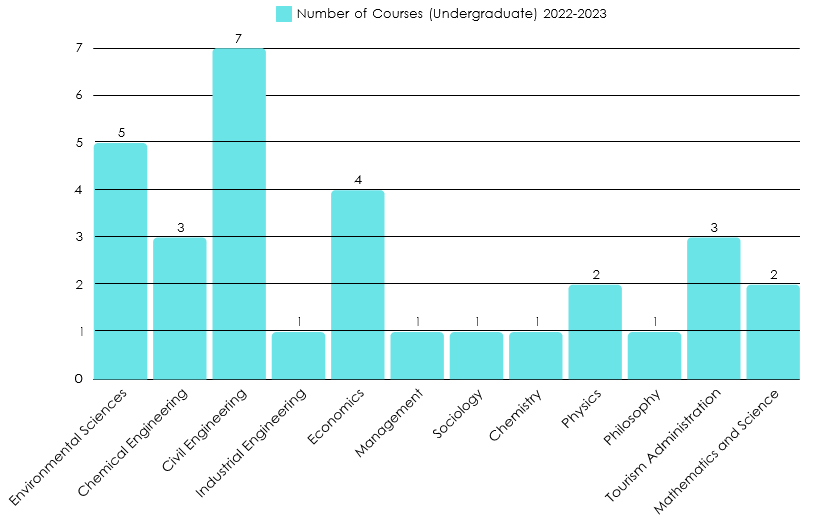
Click here for detailed information about the courses:
https://drive.google.com/file/d/1mgJC9aysmavRhUmmlXZvQqDJeaIN5x2t/view
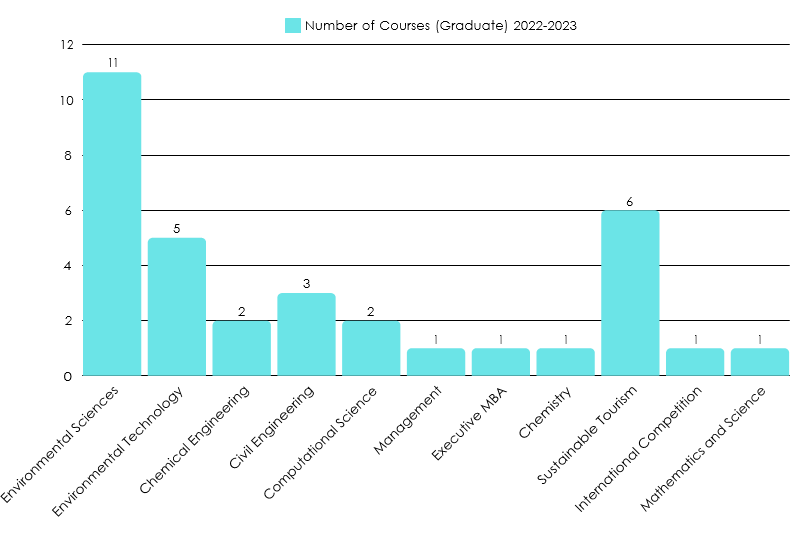
Boğaziçi University aims to educate individuals focused on sustainable development and solutions to social problems through its undergraduate and graduate programmes, which adopt an interdisciplinary approach. The University strongly reflects its responsibility to society and the environment by equipping its students with the knowledge and skills to produce effective solutions that are sensitive to global problems.
Click here for detailed information about the courses:
https://drive.google.com/file/d/1mgJC9aysmavRhUmmlXZvQqDJeaIN5x2t/view
BOĞAZİÇİ UNIVERSITY
Report on Courses Offered on Environmental Sustainability and Climate Science
This report documents the courses taught at Boğaziçi University that address the topics of environmental sustainability and climate science. The report has been prepared to serve as supporting evidence for ranking applications that require a documented overview of institutional sustainability reporting, United Nations Sustainable Development Goals (SDG) reporting, and teaching activities related to the environment and climate.
The report covers three consecutive academic terms: the Autumn and Spring terms of the 2025/2026 academic year and the Autumn term of the 2026/2027 academic year, and specifies the terms in which each course was actually taught. The accompanying workbook, entitled ‘List of Courses on Environmental Sustainability and Climate Science’, contains the full set of records and the summary tables included herein.
A total of 59 different courses related to this theme have been identified: 37 are compulsory, 18 are related, and 4 are programme components. These account for a total of 577 ECTS credits. Course provision remained stable throughout the reporting period; between 35 and 38 courses were offered in each of the three terms.
Table 1. Thematic courses by academic term
|
Academic term |
Compulsory |
Related |
Programme component |
Total |
Total ECTS |
|---|---|---|---|---|---|
|
2025/2026-1 |
22 |
10 |
4 |
36 |
405 |
|
2025/2026-2 |
24 |
7 |
4 |
35 |
409 |
|
2026/2027-1 |
24 |
10 |
4 |
38 |
420 |
|
Unique courses (excluding repeats) |
37 |
18 |
4 |
59 |
577 |
A course offered in more than one term is counted once in the deduplicated row and once for each term in the rows above it.
Table 2. Thematic courses by faculty and institute
|
Faculty / Institute |
2025/2026-1 |
2025/2026-2 |
2026/2027-1 |
Specialised courses |
|---|---|---|---|---|
|
Institute of Environmental Sciences |
23 |
27 |
24 |
36 |
|
Faculty of Engineering |
7 |
4 |
8 |
11 |
|
Graduate School of Science and Engineering |
2 |
2 |
3 |
6 |
|
Graduate School of Social Sciences |
3 |
2 |
2 |
5 |
|
Faculty of Science |
1 |
0 |
1 |
1 |
|
Total |
36 |
35 |
38 |
59 |
Table 3. Thematic subjects by level of education
|
Level of education |
2025/2026-1 |
2025/2026-2 |
2026/2027-1 |
Specialist courses |
|---|---|---|---|---|
|
Undergraduate |
8 |
4 |
9 |
12 |
|
Master’s degree |
26 |
27 |
26 |
43 |
|
PhD |
2 |
4 |
3 |
4 |
|
Total |
36 |
35 |
38 |
59 |
Table 4. Thematic lessons by sub-theme
|
Sub-theme |
Unique courses |
|---|---|
|
Sustainability management and policy |
8 |
|
Water and environmental quality |
7 |
|
Ecology and biodiversity |
6 |
|
Energy transition and renewable energy sources |
5 |
|
Programme component |
4 |
|
Environment and ecological economics |
3 |
|
Fundamentals of Environmental Science |
3 |
|
Green technology and the transition process |
3 |
|
Climate Science and Earth Systems |
2 |
|
Climate Science and Policy |
2 |
|
Energy infrastructure |
2 |
|
Environment and health |
2 |
|
Environmental chemistry |
2 |
|
Environmental modelling and data |
2 |
|
Climate adaptation and coastal systems |
1 |
|
Climate science and the atmosphere |
1 |
|
Ecology and society |
1 |
|
Energy and resource efficiency |
1 |
|
Energy storage |
1 |
|
Environmental safety and risk |
1 |
|
Sustainable built environment |
1 |
|
Sustainable mobility |
1 |
Each module is assigned a single sub-theme selected to reflect its main topic.
Course list
The table below lists all courses identified under the relevant theme, grouped by the departments in which they are taught. A tick indicates that the course is offered in the relevant term.
Table 5. Courses on environmental sustainability and climate science, by department
|
Code |
Course title |
Level |
ECTS |
Sub-theme |
2025/2026-1 |
2025/2026-2 |
2026/2027-1 |
Related |
|---|---|---|---|---|---|---|---|---|
|
Institute of Environmental Sciences — Environmental Sciences |
||||||||
|
ESC 301 |
ENVIRONMENTAL DIMENSION |
Master’s Degree |
6 |
Fundamentals of Environmental Science |
● |
● |
● |
Core |
|
ESC 305 |
GLOBAL CLIMATE CHANGE |
Master’s Degree |
6 |
Climate Science and Policy |
● |
● |
● |
Core |
|
ESC 306 |
EVOLUTION |
Master’s Degree |
6 |
Ecology and Biodiversity |
|
● |
|
Related |
|
ESC 307 |
SOCIAL ECOLOGY |
Master’s Degree |
6 |
Ecology and Society |
● |
● |
● |
Core |
|
ESC 315 |
MICROORGANISMS |
Master’s Degree |
6 |
Ecology and Biodiversity |
● |
● |
● |
Related |
|
ESC 351 |
SUSTAINABLE DEVELOPMENT |
Master’s Degree |
6 |
Sustainability management and policy |
● |
● |
● |
Core |
|
ESC 505 |
PUBLIC HEALTH AND ENVIRONMENT |
Master’s Degree |
8 |
Environment and Health |
|
● |
● |
Core |
|
ESC 509 |
RESOURCE CONSERVATION FOR ENERGY, FUELS AND CHEMICALS |
Master’s Degree |
8 |
Energy and resource efficiency |
● |
|
● |
Core |
|
ESC 510 |
GROUNDWATER FLOW AND POLLUTANT TRANSPORT |
Master’s Degree |
8 |
Water and environmental quality |
|
● |
|
Core |
|
ESC 520 |
FUNDAMENTALS OF ENVIRONMENTAL SCIENCES |
Master’s Degree |
8 |
Fundamentals of Environmental Science |
● |
|
● |
Core |
|
ESC 527 |
ENVIRONMENTAL MODELLING |
Master’s Degree |
8 |
Environmental modelling and data |
● |
|
● |
Core |
|
ESC 528 |
DRINKING WATER DISINFECTION |
Master’s Degree |
8 |
Water and environmental quality |
● |
● |
● |
Core |
|
ESC 530 |
RESEARCH METHODS FOR ENVIRONMENTAL SCIENCE SPECIALISTS |
Master’s Degree |
8 |
Fundamentals of Environmental Science |
|
● |
|
Core |
|
ESC 539 |
ENVIRONMENTAL GOVERNANCE |
Master’s Degree |
8 |
Sustainability management and policy |
● |
|
● |
Core |
|
ESC 541 |
ENVIRONMENTAL ECONOMICS |
Master’s Degree |
8 |
Environmental and Ecological Economics |
● |
|
● |
Core |
|
ESC 542 |
ECOLOGICAL ECONOMICS |
Master’s Degree |
8 |
Environmental and Ecological Economics |
|
● |
|
Core |
|
ESC 549 |
CLIMATE CHANGE POLICY |
Master’s Degree |
8 |
Climate Science and Policy |
|
● |
|
Core |
|
ESC 550 |
INSTRUMENTAL METHODS IN ENVIRONMENTAL ANALYSIS |
Master’s Degree |
8 |
Water and environmental quality |
|
● |
|
Core |
|
ESC 551 |
ENVIRONMENTAL CHEMISTRY |
Master’s Degree |
8 |
Environmental Chemistry |
● |
● |
● |
Core |
|
ESC 554 |
Bioenergy and Biofuels |
Master’s Degree |
8 |
Energy transition and renewable energy sources |
|
● |
|
Core |
|
ESC 557 |
ENVIRONMENTAL MICROBIOLOGY |
Master’s Degree |
8 |
Ecology and Biodiversity |
● |
● |
● |
Core |
|
ESC 558 |
CONCEPTS AND MODELS IN ECOLOGY |
Master’s Degree |
8 |
Ecology and Biodiversity |
● |
● |
● |
Core |
|
ESC 559 |
MOLECULAR ECOLOGY AND EVOLUTION |
Master’s Degree |
8 |
Ecology and Biodiversity |
● |
|
● |
Core |
|
ESC 569 |
MICROBIAL BIOTRANSFORMATION AND GENETICS |
Master’s Degree |
8 |
Ecology and Biodiversity |
|
● |
|
Related |
|
ESC 572 |
GLOBAL ENVIRONMENTAL SYSTEMS |
Master’s Degree |
8 |
Climate Science and Earth Systems |
● |
● |
● |
Core |
|
ESC 577 |
DYNAMIC MODELLING OF SOCIO-ECOLOGICAL SYSTEMS |
Master’s Degree |
8 |
Environmental modelling and data |
● |
|
● |
Core |
|
ESC 578 |
SYSTEMS AND SUSTAINABILITY |
Master’s Degree |
8 |
Sustainability management and policy |
|
● |
|
Core |
|
ESC 579 |
MASTER’S SEMINAR |
Master’s Degree |
2 |
Programme component |
● |
● |
● |
Programme component |
|
ESC 594 |
SPECIAL TOPICS: GREEN TRANSITION IN INDUSTRY |
Master’s Degree |
8 |
Green technology and transition |
● |
● |
|
Core |
|
ESC 595 |
SPECIAL TOPICS: DATA SCIENCE FOR WATER RESOURCES |
Master’s Degree |
8 |
Water and environmental quality |
|
● |
|
Core |
|
ESC 59Y |
SPECIAL TOPICS: ENVIRONMENTAL ASSESSMENT AND COST-BENEFIT ANALYSIS |
Master’s Degree |
8 |
Environmental and Ecological Economics |
● |
|
|
Core |
|
ESC 651 |
ENVIRONMENTAL TOXICOLOGY |
PhD |
8 |
Environment and Health |
|
● |
● |
Core |
|
ESC 653 |
ATMOSPHERIC CHEMISTRY |
Master’s Degree |
8 |
Climate Science and the Atmosphere |
|
|
● |
Core |
|
ESC 690 |
Master’s Thesis |
Master’s Degree |
60 |
Programme component |
● |
● |
● |
Programme component |
|
ESC 700 |
MASTER’S SEMINAR |
PhD |
2 |
Programme component |
● |
● |
● |
Programme component |
|
ESC 790 |
PhD Thesis |
PhD |
120 |
Programme component |
● |
● |
● |
Programme component |
|
Faculty of Engineering — Chemical Engineering |
||||||||
|
CHE 441 |
HYDROGEN TECHNOLOGIES |
Undergraduate |
5 |
Energy transition and renewable energy sources |
|
● |
|
Related |
|
CHE 443 |
RENEWABLE ENERGY TECHNOLOGIES |
Undergraduate |
5 |
Energy transition and renewable energy sources |
● |
|
● |
Core |
|
CHE 465 |
OPERATIONS AND ENVIRONMENTAL SAFETY IN CHEMICAL PLANTS |
Undergraduate |
5 |
Environmental safety and risk |
● |
|
● |
Related |
|
Faculty of Engineering — Civil Engineering |
||||||||
|
CE 231 |
EARTH SCIENCES |
Undergraduate |
5 |
Climate Science and Earth Systems |
● |
|
● |
Related |
|
CE 315 |
HYDRAULIC ENGINEERING I |
Undergraduate |
6 |
Water and environmental quality |
● |
|
● |
Related |
|
CE 322 |
SUSTAINABILITY IN CIVIL ENGINEERING |
Undergraduate |
5 |
Sustainable built environment |
|
● |
|
Core |
|
CE 414 |
COASTAL ENGINEERING |
Undergraduate |
5 |
Climate Adaptation and Coastal Systems |
● |
|
● |
Related |
|
CE 422 |
ENVIRONMENTAL ENGINEERING DESIGN |
Undergraduate |
5 |
Water and environmental quality |
● |
● |
● |
Core |
|
CE 482 |
SP.TP: MICROMOBILITY |
Undergraduate |
6 |
Sustainable mobility |
|
● |
|
Related |
|
CE 48C |
SPECIAL TOPICS: PLANNING AND DESIGN OF ENERGY FACILITIES |
Undergraduate |
5 |
Energy infrastructure |
● |
|
● |
Related |
|
CE 48V |
SPECIAL TOPICS: WATER RESOURCES, SYSTEM ANALYSIS AND SMART DECISION SUPPORT |
Undergraduate |
6 |
Water and environmental quality |
|
|
● |
Core |
|
Graduate School of Science and Engineering — Chemical Engineering |
||||||||
|
CHE 542 |
ANALYSIS OF SUSTAINABLE TECHNOLOGIES |
Master’s Degree |
8 |
Green technology and transition |
|
● |
|
Core |
|
CHE 543 |
CATALYSIS FOR GREEN TECHNOLOGIES |
Master’s Degree |
8 |
Green technology and transition |
● |
|
● |
Core |
|
CHE 581 |
SPECIAL TOPICS: SUPERCAPACITOR TECHNOLOGIES |
Master’s Degree |
8 |
Energy storage |
|
|
● |
Related |
|
Institute of Science and Engineering — Chemistry |
||||||||
|
CHEM528 |
ENERGY SOURCES |
Master’s Degree |
8 |
Energy transition and renewable energy sources |
|
|
● |
Related |
|
CHEM596 |
SPECIAL TOPICS: ALTERNATIVE ENERGY SOURCES OF THE FUTURE |
Master’s Degree |
8 |
Energy transition and renewable energy sources |
● |
|
|
Related |
|
Institute of Science and Engineering — Civil Engineering |
||||||||
|
CE 681 |
SPECIAL TOPICS: FUNDAMENTALS OF ENERGY GEOTECHNICS AND THERMOACTIVE GEOSTRUCTURES |
PhD |
10 |
Energy infrastructure |
|
● |
|
Related |
|
Graduate School of Social Sciences — Sustainable Tourism Management |
||||||||
|
TRM 521 |
DESTINATION DEVELOPMENT FOR SUSTAINABLE TOURISM |
Master’s Degree |
7 |
Sustainability management and policy |
● |
|
● |
Related |
|
TRM 522 |
ENVIRONMENT, SUSTAINABILITY AND TOURISM |
Master’s Degree |
7 |
Sustainability management and policy |
|
● |
|
Core |
|
TRM 525 |
SUSTAINABLE BUSINESS DEVELOPMENT |
Master’s Degree |
7 |
Sustainability management and policy |
● |
|
● |
Related |
|
TRM 526 |
CORPORATE SOCIAL RESPONSIBILITY AND GOVERNANCE |
Master’s Degree |
7 |
Sustainability management and policy |
● |
|
|
Related |
|
TRM 543 |
ALTERNATIVE FORMS OF TOURISM |
Master’s Degree |
7 |
Sustainability management and policy |
|
● |
|
Related |
|
Faculty of Science — Chemistry |
||||||||
|
CHEM471 |
ENVIRONMENTAL CHEMISTRY |
Undergraduate |
6 |
Environmental Chemistry |
● |
|
● |
Core |
Course titles have been reproduced as they appear in the institution’s catalogue. ● = a course offered during that term.
