


16.2.3 Identify and engage with local stakeholders
Identifying and Engaging Local Stakeholders
Boğaziçi University Stakeholder Engagement Policy
EDUCATION AND TEACHING POLICY
- To produce graduates with the competence to adapt to a changing world through learning-focused education and teaching programmes designed according to local, national, regional and global needs,
- To produce graduates who embrace ethical values, show the highest level of care and respect for people and the environment, use knowledge and technology effectively, are self-confident and able to express themselves, and think critically,
- To cultivate individuals who embrace ethical values, demonstrate the highest level of care and respect for people and the environment, use knowledge and technology effectively, are self-confident and articulate, and possess critical thinking, project-based and teamwork skills,
- To cultivate individuals who question and explore issues at local, national, regional and global levels, analyse and understand them, solve them using their knowledge base, and become pioneering experts in their fields,
- To continuously monitor and improve all programmes offering undergraduate and postgraduate education and training, ensuring stakeholder participation in line with programme objectives and competencies,
- To ensure inclusivity and accessibility in the delivery of education and training activities,
- To ensure the seamless and uninterrupted provision of student guidance, academic counselling, career and social support services in face-to-face, distance, digital and blended learning processes.
RESEARCH POLICY
- Prioritising and supporting studies in engineering, technology, social and human sciences, management sciences, natural sciences, education and law at local, national, regional and global levels in line with development goals,
- Creating incentive mechanisms to increase the quality of research and researcher performance,
- Developing national and international collaborations and projects in line with BÜ’s research strategy, converting externally funded projects and university–industry collaboration outputs into added value,
- Adopting scientific ethics in all research processes,
- Continuously improving research processes by monitoring them at regular intervals,
- Sharing research infrastructure, expertise and outputs for the purpose of social contribution,
- Increasing collaboration with external stakeholders by developing systems for knowledge and technology transfer.
SOCIAL CONTRIBUTION POLICY
- Prioritising interdisciplinary education and research aimed at meeting social needs and solving problems at the local, national, regional and global levels, in line with the United Nations Sustainable Development Goals,
- Directly participating in and leading social service processes in collaboration with policy-making and implementing public, private and civil society institutions and organisations,
- Being sensitive to human and animal rights and environmentally friendly with an inclusive university identity,
- Continuing to strengthen the sharing of scientific knowledge and physical infrastructure and facilities with society.
INTERNATIONALISATION POLICY
- Conducting all education, training, research and social contribution activities carried out within the university in line with international standards,
- Continuing and developing the pioneering and innovative perspective adopted in international processes,
- Planning, implementing and monitoring activities that enhance the university’s international recognition, visibility and position,
- Transferring the knowledge and experience gained in the areas of service through international collaborations,
- Undertaking the necessary work to attract qualified international students and researchers,
- Increasing the number of programmes with international accreditation.
LEADERSHIP, GOVERNANCE AND QUALITY
- Implementing sustainable quality management processes in all units with an effective leadership approach and team spirit in order to achieve the objectives in the areas of education and training, research and development, internationalisation, entrepreneurship, institutional capacity development and social contribution,
- Adopting the monitoring and continuous improvement of all processes in line with our university’s strategic goals and objectives, national and international compliance obligations, and the requirements of the era,
- Using resources effectively and efficiently,
- Placing importance on specialisation in priority areas,
- Employing competent and qualified personnel,
- Encouraging open communication and coordinating cooperation between units,
- Producing timely, accurate and reliable information,
- Ensuring quality and continuity in product and service production,
- Identifying and managing corporate risks,
- Ensuring transparency and accountability in the tasks performed,
- Establishing and implementing a governance system that provides services to all stakeholders without discrimination and in compliance with the legislation,
- Adopting a governance approach that enables stakeholders to participate in decision-making processes.
Boğaziçi University has written policies and procedures for identifying and engaging with local stakeholders. The University's Strategic Plan emphasizes the importance of collaborating with local and regional stakeholders and establishes guidelines for this purpose. In addition, each faculty and department has its own advisory boards. These structures facilitate interaction with local stakeholders and develop strategies to integrate community input into the university's decision-making processes.
The Boğaziçi University Quality Assurance Directive describes the processes governing the university's relations with its internal and external stakeholders. The Quality Commission regularly collects and analyzes the opinions and suggestions of internal and external stakeholders and communicates this information to the relevant units. This provides a structure for building strong collaboration with local communities and meeting their needs.
In addition, Boğaziçi University coordinates the United Nations Sustainable Development Solutions Network (UN SDSN) in Turkey. This network promotes collaboration and networking with local and national stakeholders towards sustainable development goals.
Related Links:
- Boğaziçi University Quality Assurance Guidelines
- Boğaziçi University Strategic Plan (2020-2024)
- Boğaziçi University Stakeholder Analysis Report
- Boğaziçi University Stakeholder Analysis Surveys
- Boğaziçi University & UN SDSN Turkey
2024 Sustainability Report SDG-16 (Related Section)
Identification and Participation of Local Stakeholders
Boğaziçi University has developed written policies and procedures to identify local stakeholders and develop effective co-operation with them. Within the scope of the University's Stakeholder Engagement Policy, individuals, groups and institutions that affect or are affected by the University are identified through a systematic process.
Stakeholder Identification Process
1. Identification of Stakeholders:
- Stakeholders are defined as public institutions, non-governmental organisations, private sector representatives and other relevant groups that affect or are affected by the university.
- Academic and administrative staff are the internal stakeholders of the university, while alumni, students, parents, other public institutions, private institutions and organisations are the external stakeholders.
2. Analysis:
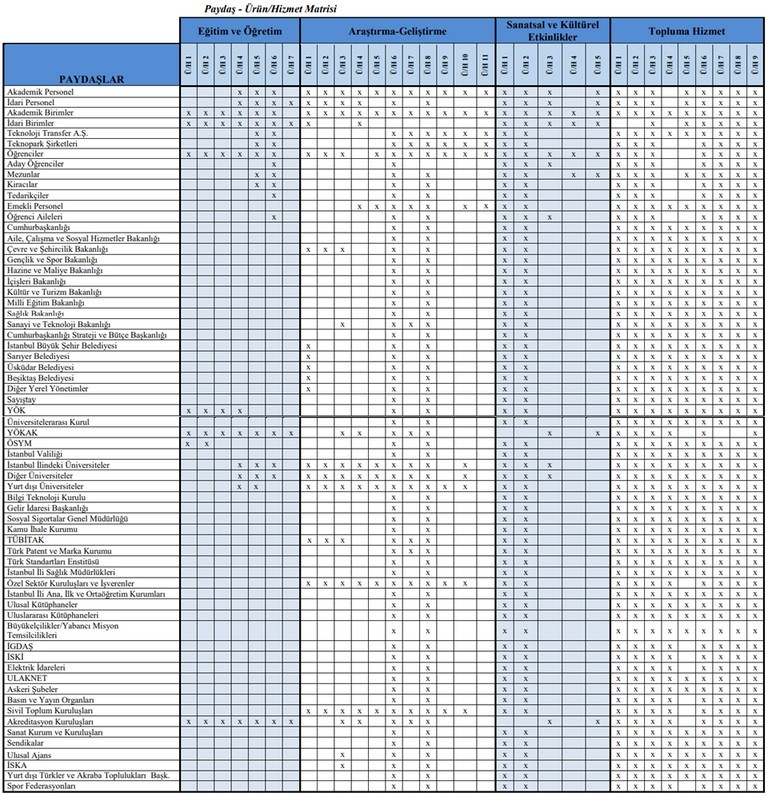
- The relations, strengths, needs and expectations of the identified stakeholders with the university are analysed.
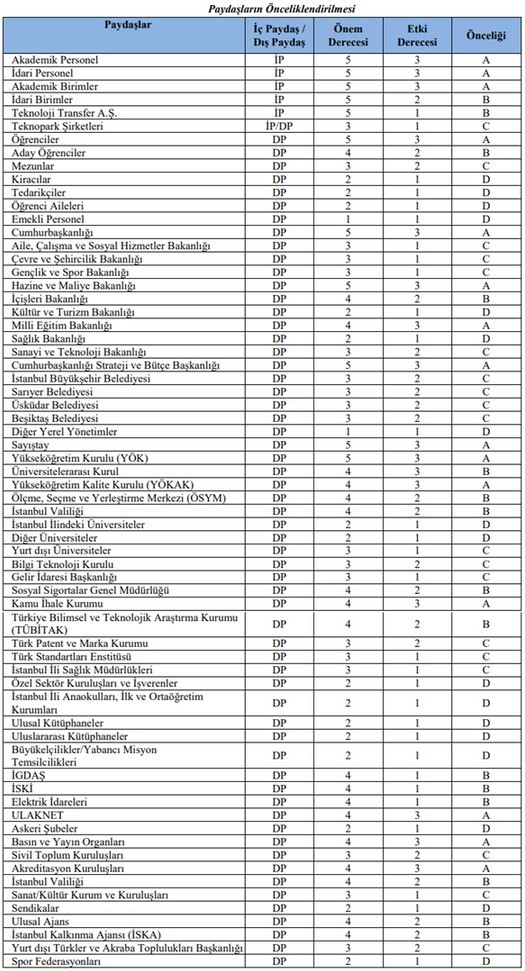
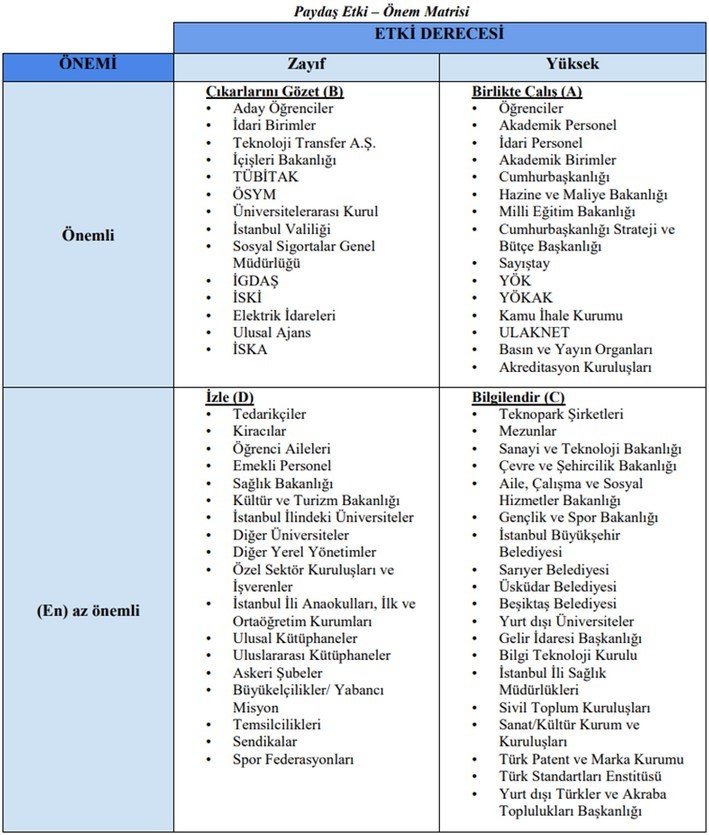
- Stakeholder-product/service matrix and stakeholder impact/importance matrices are used to evaluate the impact and importance of stakeholders on the university.
3. Grouping and Prioritisation:
- Stakeholders are assessed according to their importance (between 1-5) and impact (weak, medium, high).
- Based on the data obtained, stakeholders are classified as high priority (A), priority (B), low priority (C) and low priority (D).
Considerations in Stakeholder Analysis
- Surveys aim to reach as wide a group of participants as possible.
- Confidentialityis of utmost importance in order for stakeholders to express their views freely.
- In the prioritisation process, past relationships of stakeholders, current higher education dynamics and practices of other universities are taken into consideration.
Stakeholder Engagement Processes
- The questionnaires developed to obtain the views of stakeholders were approved by the Boğaziçi University Ethics Committee and administered on a voluntary basis.
- The opinions were evaluated in order to shape strategic plans and organise public services according to the needs of beneficiaries.
- These processes ensure that stakeholders adopt and support the strategic goals of the university.
These written policies and processes make it possible for Boğaziçi University to establish strong co-operation with local stakeholders and to maintain this co- operation in a way that contributes to strategic goals.
Click here to see the Stakeholder Engagement Policy:
https://mediastore.cc.bogazici.edu.tr/web/userfiles/files/paydas_katilimi_politikasi.pdf
Click here to see the stakeholder surveys:
https://sgdb.bogazici.edu.tr/paydas-analizi-anketleri
Click here to see the Stakeholder Analysis Report:
https://sp.bogazici.edu.tr/sites/sp.boun.edu.tr/files/paydas_analizi_raporu.pdf
